

DPM Metals Extends Mineralization at Dumitru Potok with High-Grade Intercepts
TORONTO, Sept. 08, 2026 (GLOBE NEWSWIRE) -- DPM Metals Inc. (TSX: DPM, ASX: DPM) (ARBN: 689370894) (“DPM” or “the Company”) today reported intercepts from drilling at the Dumitru Potok and Rakita North copper-gold-silver prospects, located on the Čoka Rakita exploration licence.
Highlights include:
- Extension of Dumitru Potok mineralization: Drilling extends the marble-hosted intrusive skarn mineralization approximately 90 metres west and 100 metres southwest (drillholes BIDD253 and DPDD037A) and returned encouraging results 300 metres to the north of the Mineral Resource (DPDD039A), indicating further expansion potential at shallow levels.
- Targets remain open: Results demonstrate further growth potential at Dumitru Potok and Rakita North, with mineralization open along strike, laterally and at depth, including priority extensions to the west and southwest of the existing Dumitru Potok Mineral Resource, and to the north and east at Rakita North. These results improve the Company’s understanding of mineralization geometry and indicate mineralized tonnage may be greater than previously modelled.
- Increased drilling program: DPM is expanding the 2026 drilling program by an additional 12,000 to 15,000 metres, increasing planned drilling for the year to approximately 32,000 to 35,000 metres. The drilling program will focus on expanding the existing Dumitru Potok Mineral Resource estimate, infill drilling and target testing across the Čoka Rakita exploration licence.
- PEA to be completed by year end 2027: An updated Dumitru Potok Mineral Resource estimate is expected to be complete by the end of the first quarter of 2027, which will form the basis of a Preliminary Economic Assessment (“PEA”) targeted to be complete by the end of 2027.
-
Selected intercepts include:
- BIDD253: 246 metres grading 1.36% CuEq, comprising 0.67% Cu, 0.69 g/t Au and 4.21 g/t Ag from 1,377 metres downhole, including 26 metres grading 2.07% CuEq, comprising 0.76% Cu, 1.33 g/t Au and 4.48 g/t Ag.
- BIDD254: 30 metres grading 1.56% CuEq, comprising 0.85% Cu, 0.68 g/t Au and 5.92 g/t Ag from 761 metres downhole, and 29 metres grading 1.29% CuEq, comprising 0.70% Cu, 0.57 g/t Au, and 4.96 g/t Ag from 843 metres downhole.
- DPDD041: 84 metres grading 2.06% CuEq, comprising 0.71% Cu, 1.37 g/t Au and 4.88 g/t Ag from 1,085 metres downhole, and 51 metres grading 2.17% CuEq, comprising 0.87% Cu, 1.30 g/t Au and 6.20 g/t Ag from 1,320 metres downhole.
- DPDD042: 50 metres grading 3.68% CuEq, comprising 2.18% Cu, 1.36 g/t Au and 21.75 g/t Ag from 761 metres downhole, including 21 metres grading 5.44% CuEq, comprising 3.80% Cu, 1.33 g/t Au and 37.63 g/t Ag from 772 metres downhole.
-
RADDGTH009C: 76 metres grading 2.66% CuEq, comprising 1.76% Cu, 0.88 g/t Au and 7.30 g/t Ag from 623 metres downhole, including 33 metres grading 3.51% CuEq, comprising 2.40% Cu, 1.07 g/t Au and 9.68 g/t Ag from 655 metres downhole.
See Table 1 and associated footnotes for full results from drilling and for details on the copper equivalent calculation.
“With mineralization open in all directions, we are increasing our 2026 drilling program for the Rakita Camp up to 35,000 metres as we pursue what we believe is a district-scale discovery,” said David Rae, President and Chief Executive Officer of DPM Metals.
“These results extend mineralization 100 metres beyond the existing Mineral Resource and continue to demonstrate Dumitru Potok’s significant growth potential.
“DPM’s strong local presence in the region for over 20 years, strong relationships within local communities, demonstrated commitment to rigorous safety and environmental standards and track record as a responsible operator in the Balkans are the foundation of our approach to value creation.
“We are proceeding with a preliminary economic assessment, expected to be complete by year-end 2027, demonstrating our excitement and confidence in the Rakita Camp’s potential as a Tier One asset in our portfolio.”
Dumitru Potok prospect
The intensive exploration program at the Čoka Rakita licence, which was initiated in the second quarter of 2026 following the ordinary course renewal of the exploration permit, is proceeding according to plan. The 2026 drilling program is focused on further delineating the full extent of the Mineral Resource reported in late 2025, as well as infill of the high-grade area of the western contact-skarn extension of the known mineralization domain (Figure 1). Results received to date demonstrate potential to expand mineralization along strike and laterally beyond the existing Mineral Resource, while the infill drilling results align well with existing interpretations. For more information regarding the Mineral Resource estimate for Dumitru Potok, refer to the news release dated December 2, 2025, available on our website at www.dpmmetals.com.
Holes BIDD253 and DPDD037A intersected mineralization approximately 90 metres west (Figure 2) and 100 metres southwest, respectively, of the existing Mineral Resource. BIDD253 was designed to target marble-hosted mineralization between the Frasen and Dumitru Potok quartz monzodiorite intrusions. The drillhole returned 33 metres grading 1.42% CuEq from 1,003 metres downhole, 52 metres grading 1.61% CuEq from 1,252 metres and 246 metres grading 1.36% CuEq from 1,377 metres downhole, which includes 25 metres of stratabound mineralization at 2.38% CuEq from 1,429 metres downhole, and 26 metres of contact-skarn mineralization at 2.07% CuEq from 1,594 metres downhole.
At shallow levels, copper mineralization is dominated by chalcopyrite, with bornite becoming more abundant toward the Dumitru Potok intrusion and locally transitioning to digenite, chalcocite and trace native copper. Near the Frasen intrusion, intensely altered marble hosts mineralization in stockwork veins and karst features, while deeper garnet skarn is strongly replaced by goethite, calcite and silica. Further downhole, drillhole BIDD253 supports a northwest-trending feeder structure at depth that separates iron oxide-hosted mineralization in the hanging wall from bornite-chalcopyrite-chalcocite carbonate replacement-style mineralization in the footwall.
To the southwest, DPDD037A intersected several intervals of marble-hosted skarn mineralization, highlighted by 30 metres grading 1.18% CuEq from 701 metres and 21.4 metres grading 0.75% CuEq from 795 metres downhole. These intervals are located approximately 100 metres southwest of the existing Mineral Resource domain. The hole encountered repeated intervals of marble and quartz monzodiorite (Figure 3).
At similar depths, drillhole DPDD045, located east of DPDD037A, intersected quartz monzodiorite, suggesting an east-west-trending fault structure between the two holes. The structure is interpreted to have normal and dextral displacement of the intrusion. Additional drilling is planned to refine the geological interpretation in this area.
DPDD041, the first infill drillhole to date, was completed on an approximately 50-metre spacing between DPDD026 and DPDD032. Consistent with nearby drillholes, the hole intercepted two zones of skarn mineralization, with an upper interval of stratabound mineralization returning 84 metres grading 2.06% CuEq (0.71% Cu, 1.37 g/t Au, 4.88 g/t Ag) from 1,085 metres downhole, and a lower interval of contact-skarn mineralization returning 51 metres grading 2.17% CuEq (0.87% Cu, 1.30 g/t Au, 6.20 g/t Ag) from 1,320 metres.
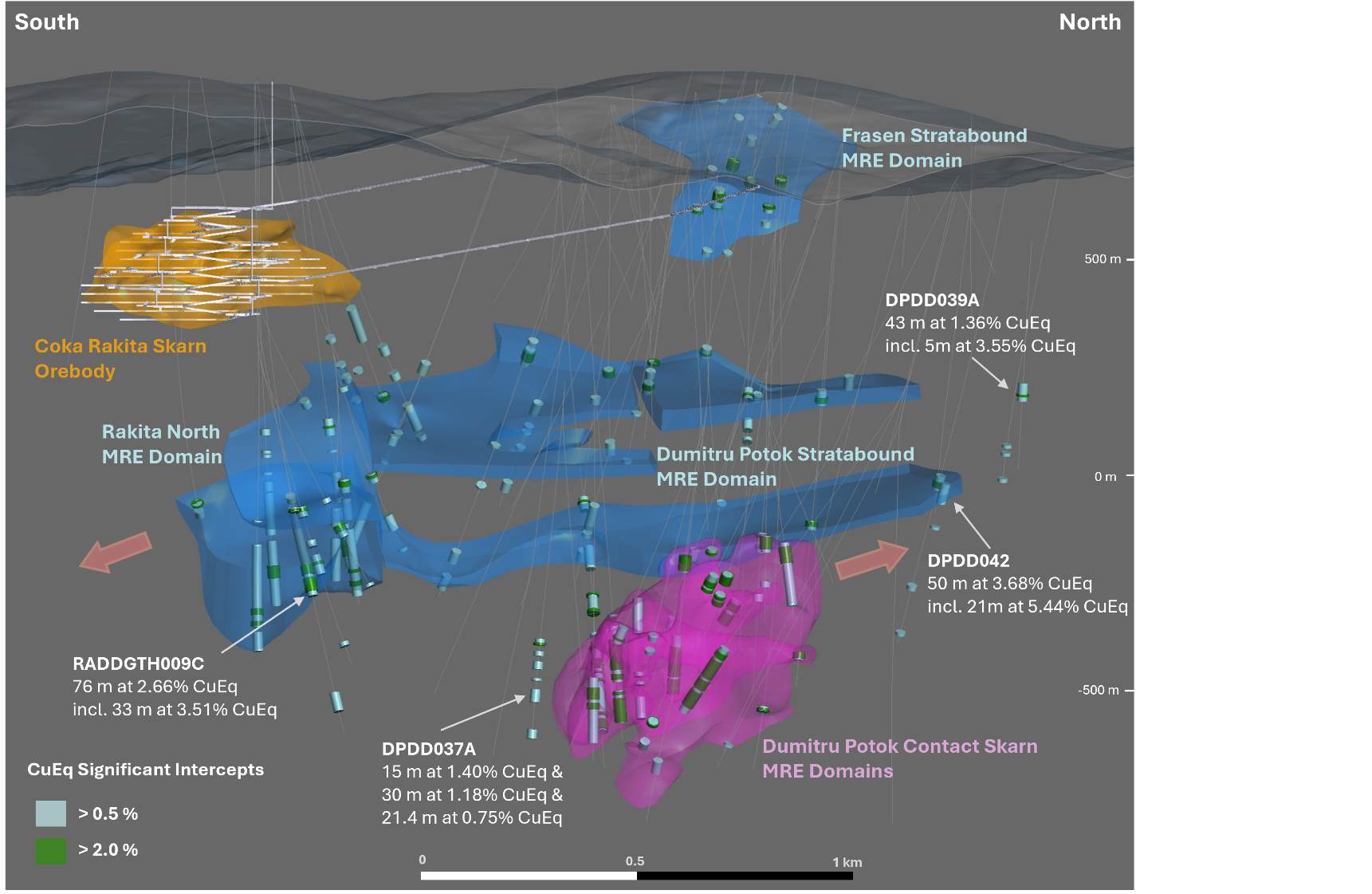
Drillhole DPDD042 confirmed the northward extension of Cu-Au-Ag stratabound-manto mineralization (Figure 4) along the upper marble contact, previously intersected by DPDD028, which returned 36 metres grading 1.50% CuEq (1.13% Cu, 0.29 g/t Au, 8.57 g/t Ag) from 752 metres downhole, with mineralization hosted in dominantly garnet-altered skarn.
In contrast, DPDD042 returned a longer and higher-grade intercept of 50 metres grading 3.68% CuEq (2.18% Cu, 1.36 g/t Au, 21.75 g/t Ag) from 761 metres downhole, including 21 metres grading 5.44% CuEq (3.80% Cu, 1.33 g/t Au, 37.63 g/t Ag) from 772 metres. Mineralization consists of chalcopyrite and bornite hosted in garnet, iron-hydroxide, calcite, and silica-altered skarn, with elevated Au and Ag values present in strongly oxidized skarn where primary garnet is intensively replaced by a goethite-calcite assemblage. The observed mineralization style and higher grades suggest that DPDD042 may be closer to the intrusive source interpreted to have driven mineralization, providing a vector for further drilling in the area.
Approximately 300 metres north from the existing Mineral Resource, DPDD039A returned 43 metres grading 1.36% CuEq (0.94% Cu, 0.35 g/t Au, 7.78 g/t Ag) from 336 metres downhole, including 5 metres grading 3.55% CuEq (2.21% Cu, 1.30 g/t Au, 10.52 g/t Ag). This interval is interpreted to be stratabound mineralization that is hosted by the basal breccia unit and appears at a shallower setting relative to the nearby drillhole DPDD038. Based on the logged geology, the presence of a northwest-trending fault is interpreted between DPDD038 and DPDD039A, which down-drops the stratigraphy to the east.
While not a primary focus of this release, shallow gold-copper porphyry mineralization at Frasen remains an important part of the ongoing drilling campaign. Many of the drillholes targeting marble-hosted mineralization at depth also serve a dual purpose by testing the Frasen porphyry system at shallow levels.
Rakita North prospect
Drillhole RADDGTH009C tested the northeastern extension of mineralization at Rakita North (Figure 4), intersecting a continuous mineralized interval within a marble package that is down-dropped by approximately 70 metres relative to surrounding holes, suggesting displacement along a fault structure in this area. The hole returned 76 metres grading 2.66% CuEq (1.76% Cu, 0.88 g/t Au, 7.30 g/t Ag) from 623 metres downhole, supporting continuity of mineralization in the northeastern portion of the Rakita North Mineral Resource and indicating potential for further extension of higher-grade mineralization at depth.
Mineralization is predominantly composed of chalcopyrite, with lesser bornite, and is hosted within predominantly garnet-altered marble that is partially replaced by goethite and calcite. Alteration and sulphide mineralization are developed along the upper manto contact and lower stratabound levels, as well as within structurally controlled stockwork veins within the marble.
Across all reported holes, stratabound-manto mineralization is typically hosted in garnet-altered marble and is dominated by chalcopyrite ± bornite. Closer to the Dumitru Potok intrusive contact, garnet is pervasively replaced by goethite, calcite, and silica, and is accompanied by a sulphur-deficient assemblage, including chalcocite, digenite, and native copper.
Mineralization Remains Open for Further Growth
At Dumitru Potok, eight rigs are currently dedicated to follow-up drilling to test the continuity and extensions of the western and eastern marble-hosted contact-skarn zones, as well as stratabound mineralization (Figure 3). From this total, two rigs are dedicated to 50-metre by 50-metre infill drilling in the high-grade area of the western contact-skarn zone, with the goal of improving geological confidence, verifying mineralization continuity and potentially upgrading the Mineral Resource category.
Defining the lateral extent of the marble-hosted skarn mineralization is also a priority, with two rigs currently drilling the area between the Dumitru Potok and Frasen intrusions. Within this corridor, contact-skarn mineralization is interpreted to have the potential to extend sub-horizontally for up to 250 metres from the causative intrusions.
Recent results indicate that the Rakita North target remains open to the north and east, and that marble units extend to greater depths in this area. The Company continues to explore for a potential intrusive source associated with mineralization.
Next Steps
The Company’s intensive camp-wide exploration campaign is progressing according to plan, with 10 rigs currently operating across the Čoka Rakita exploration licence and more than 16,000 metres drilled to date, of the 20,000 metres originally planned for 2026. In light of the encouraging new results, DPM plans to expand the 2026 drilling program by an additional 12,000 to 15,000 metres, increasing planned drilling for the year to approximately 32,000 to 35,000 metres.
Following the completion of the initial three-year term of the Potaj Čuka and Pešter Jug licences in the third quarter of 2026, drilling is expected to pause while the Company completes the normal-course licence-extension process. During this period, DPM plans to relocate drilling equipment to the Čoka Rakita exploration licence, which will increase the number of rigs in operation on the licence to 15 by the end of 2026. The expanded program will include more drilling at Rakita North and Dumitru Potok, at the Frasen porphyry target, and scout drilling east and south of the Čoka Rakita deposit.
Current priorities include targeted step-out drilling to test the potential to expand mineralization beyond the existing Mineral Resource. The Company also plans to continue infill drilling to improve geological confidence and verify mineralization continuity.
Additional metallurgical testwork is being planned, designed to further evaluate mineralization variability and to augment the results of previous testwork programs.
The Company plans to update the Mineral Resource estimate for the project by the end of the first quarter of 2027. This will form the basis of a Preliminary Economic Assessment targeted for completion by the end of 2027.
Table 1. Drillhole results from the target delineation drilling campaign testing stratabound and marble-hosted skarn targets at the Dumitru Potok and Rakita North Prospects
|
HOLEID |
EAST |
NORTH |
RL |
AZ |
DIP |
FROM | TO | LENGTH | CuEq | Cu | Au | Ag | |||
| (m) | (m) | (m) | (%) | (%) | (g/t) | (g/t) | |||||||||
| BIDD253 | 572379 | 4896707 | 903 | 77 | -78 | 1003 | 1036 | 33 | 1.42 | 0.59 | 0.85 | 1.75 | |||
| including | 1013 | 1018 | 5 | 2.18 | 1.08 | 1.13 | 2.53 | ||||||||
| and | 1077 | 1086 | 9 | 0.65 | 0.39 | 0.25 | 1.37 | ||||||||
| and | 1129 | 1187 | 58 | 0.52 | 0.27 | 0.26 | 1.44 | ||||||||
| and | 1252 | 1304 | 52 | 1.61 | 1.01 | 0.56 | 6.98 | ||||||||
| including | 1253 | 1258 | 5 | 2.95 | 1.99 | 0.83 | 16.60 | ||||||||
| including | 1295 | 1304 | 9 | 2.00 | 1.47 | 0.49 | 6.47 | ||||||||
| and | 1358 | 1365 | 7 | 0.82 | 0.27 | 0.57 | 1.35 | ||||||||
| and | 1377 | 1623 | 246 | 1.36 | 0.67 | 0.69 | 4.21 | ||||||||
| including | 1392 | 1401 | 9 | 2.32 | 1.70 | 0.55 | 9.49 | ||||||||
| including | 1429 | 1454 | 25 | 2.38 | 1.27 | 1.08 | 9.28 | ||||||||
| including | 1463 | 1468 | 5 | 3.69 | 2.13 | 1.52 | 11.62 | ||||||||
| including | 1483 | 1490 | 7 | 2.29 | 1.21 | 1.03 | 10.46 | ||||||||
| including | 1575 | 1583 | 8 | 3.23 | 1.84 | 1.30 | 15.79 | ||||||||
| including | 1594 | 1620 | 26 | 2.07 | 0.76 | 1.33 | 4.48 | ||||||||
| BIDD254 |
572226 |
4897172 |
922 |
97 |
-80 |
in progress | |||||||||
| 761 | 791 | 30 | 1.56 | 0.85 | 0.68 | 5.92 | |||||||||
| including | 777 | 783 | 6 | 4.92 | 2.56 | 2.29 | 18.35 | ||||||||
| and | 843 | 872 | 29 | 1.29 | 0.70 | 0.57 | 4.96 | ||||||||
| and | 895 | 904 | 9 | 1.55 | 0.66 | 0.90 | 2.87 | ||||||||
| DPDD037A | 572884 | 4896725 | 195 | 129 | -82 | 583 | 598 | 15 | 1.40 | 0.51 | 0.91 | 2.33 | |||
| including | 592 | 598 | 6 | 2.05 | 0.66 | 1.43 | 3.04 | ||||||||
| and | 612 | 623 | 11 | 0.73 | 0.28 | 0.46 | 1.49 | ||||||||
| and | 636 | 654 | 18 | 0.98 | 0.30 | 0.70 | 1.57 | ||||||||
| and | 675 | 681 | 6 | 1.46 | 0.51 | 0.95 | 3.66 | ||||||||
| and | 701 | 731 | 30 | 1.18 | 0.50 | 0.68 | 3.16 | ||||||||
| and | 795 | 816.4 | 21.4 | 0.75 | 0.29 | 0.46 | 2.18 | ||||||||
| DPDD037B | 572883 | 4896726 | 217 | 144 | -83 | in progress | |||||||||
| DPDD038 | 572824 | 4897882 | 731 | 239 | -70 | 703 | 710 | 7 | 0.66 | 0.53 | 0.12 | 2.12 | |||
| and | 722.2 | 730 | 7.8 | 0.65 | 0.46 | 0.10 | 8.99 | ||||||||
| and | 784.9 | 793.7 | 8.8 | 0.58 | 0.38 | 0.19 | 2.34 | ||||||||
| DPDD039 | 572617 | 4897833 | 764 | 239 | -80 | aborted for technical reasons | |||||||||
| DPDD039A | 572586 | 4897813 | 547 | 241 | -81 | 336 | 379 | 43 | 1.36 | 0.94 | 0.35 | 7.78 | |||
| including | 363 | 368 | 5 | 3.55 | 2.21 | 1.30 | 10.52 | ||||||||
| DPDD039B | 572519 | 4897784 | 74 | 249 | -81 | aborted for technical reasons | |||||||||
| DPDD040 | 573800 | 4897771 | 723 | 269 | -65 | no significant intervals | |||||||||
| DPDD041 | 572776 | 4896889 | 786 | 85 | -85 | 1085 | 1169 | 84 | 2.06 | 0.71 | 1.37 | 4.88 | |||
| including | 1086 | 1097 | 11 | 2.10 | 0.06 | 2.14 | 0.42 | ||||||||
| including | 1106 | 1119 | 13 | 2.13 | 0.29 | 1.92 | 1.71 | ||||||||
| including | 1127 | 1132 | 5 | 5.32 | 1.82 | 3.56 | 12.22 | ||||||||
| including | 1140 | 1155 | 15 | 4.66 | 2.89 | 1.67 | 19.13 | ||||||||
| and | 1261 | 1271 | 10 | 0.94 | 0.40 | 0.53 | 2.87 | ||||||||
| and | 1283.5 | 1291 | 7.5 | 1.92 | 0.77 | 1.15 | 5.97 | ||||||||
| and | 1320 | 1371 | 51 | 2.17 | 0.87 | 1.30 | 6.20 | ||||||||
| including | 1327 | 1338 | 11 | 4.59 | 1.99 | 2.64 | 9.62 | ||||||||
| including | 1356 | 1371 | 15 | 2.67 | 1.13 | 1.52 | 9.77 | ||||||||
| DPDD042 | 572984 | 4897754 | 700 | 245 | -70 | 761 | 811 | 50 | 3.68 | 2.18 | 1.36 | 21.75 | |||
| including | 772 | 793 | 21 | 5.44 | 3.80 | 1.33 | 37.63 | ||||||||
| including | 803 | 810 | 7 | 8.20 | 3.12 | 5.02 | 30.71 | ||||||||
| and | 867 | 874 | 7 | 0.61 | 0.27 | 0.34 | 2.02 | ||||||||
| DPDD043 | 573648 | 4897328 | 633 | 248 | -73 | aborted for technical reasons | |||||||||
| DPDD044 | 573837 | 4896962 | 656 | 214 | -80 | aborted for technical reasons | |||||||||
| DPDD045 | 573311 | 4896779 | 711 | 200 | -77 | no significant intervals | |||||||||
| DPDD045A | 573279 | 4896695 | 325 | 203 | -77 | in progress | |||||||||
| DPDD046 | 572722 | 4896958 | 775 | 92 | -79 | in progress | |||||||||
| DPDD047 | 573711 | 4897660 | 726 | 230 | -60 | in progress | |||||||||
| DPDD048 | 573308 | 4896621 | 744 | 220 | -69 | in progress | |||||||||
| DPDD049 | 572724 | 4897373 | 772 | 75 | -80 | in progress | |||||||||
| RADDGTH009C | 573052 | 4896010 | 395 | 332 | -88 | 487 | 496 | 9 | 1.89 | 1.28 | 0.59 | 4.46 | |||
| including | 489 | 494 | 5 | 2.33 | 1.61 | 0.70 | 5.52 | ||||||||
| and | 623 | 699 | 76 | 2.66 | 1.76 | 0.88 | 7.30 | ||||||||
| including | 624 | 647 | 23 | 2.99 | 1.89 | 1.09 | 7.42 | ||||||||
| including | 655 | 688 | 33 | 3.51 | 2.40 | 1.07 | 9.68 | ||||||||
| and | 935 | 980 | 45 | 0.60 | 0.39 | 0.19 | 2.02 | ||||||||
| RADDGTH009D | 573051 | 4896011 | 377 | 328 | -87 | in progress | |||||||||
1) Coordinates are reported in UTM Zone 34 North WGS84 datum.
2) Intervals are reported at a cut-off grade of 0.5% CuEq using 5 metres minimum length and 10 metres maximum internal dilution. Higher grade sub-intervals denoted with ‘including’ are reported at a cut-off grade of 2% CuEq using 5 metres minimum length and 5 metres maximum internal dilution.
3) The CuEq calculation is based on the following formula: Cu (%) + [Au (g/t) x 0.95] + [Ag (g/t) x 0.01] based on a copper price of $3.85 /lb, gold price of $2,600/oz and silver price of $26/oz; and assumes metallurgical recoveries of 90% for all metals within the equivalency calculation, based on early-stage metallurgical testwork.
4) Reported interval lengths are downhole lengths. Based on the current geological interpretation, the true widths of the stratabound mineralization are estimated to be approximately 90% or more of the reported downhole intervals. Drillhole intersections with contact-skarn mineralization in DPDD041 and BIDD253 are less favourably oriented relative to the interpreted mineralization geometry; accordingly, true widths are expected to be less than the reported downhole intervals but cannot yet be reliably estimated.
5) Daughter holes identified with “A” (e.g., DPDD037A) are navigational holes. The coordinates reported represent the point at which the daughter hole exits the parent hole.
6) For holes identified as “in progress,” reported intervals reflect assay results received as of September 8, 2026. Drilling and/or assay results for the remaining portions of these holes are pending.
Figure 1. Project-scale plan map showing the Čoka Rakita and Potaj Čuka exploration licences, 2025 Mineral Resource estimate domains, selected recently reported drillholes, pending and previously reported drillholes.
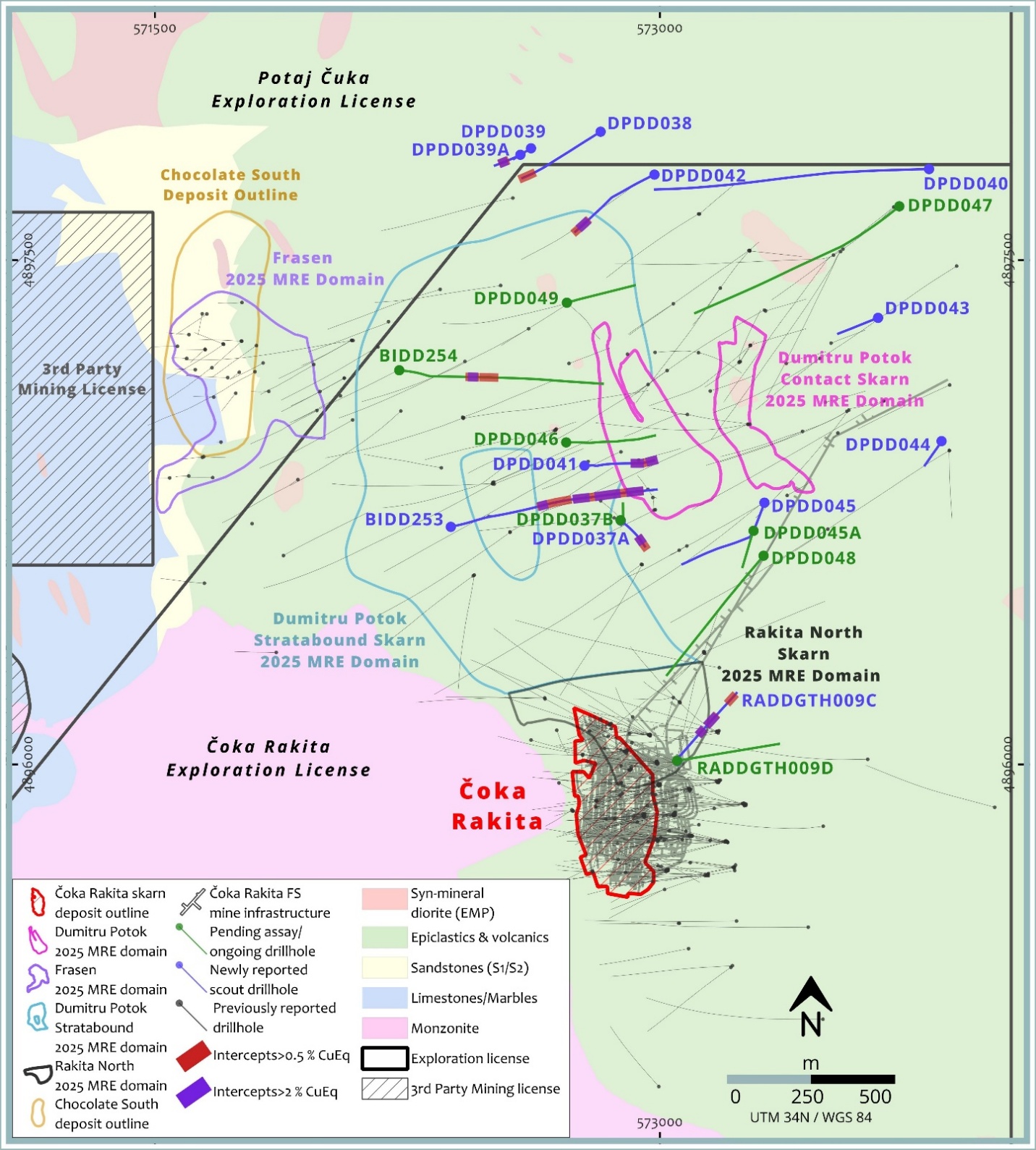
Figure 2. West–east cross-section 4896770N, projected over a 300-metre thickness, showing lithology, interpreted faults, 2025 Mineral Resource estimate domains and drillholes across the Frasen and Dumitru Potok targets. Highlighted callouts show selected newly reported intercepts from BIDD253 and DPDD041.
Figure 3. Inclined section of the Dumitru Potok contact-skarn area, showing the 2025 Mineral Resource domains, lithology, interpreted faults and drillhole traces. Highlighted callouts show selected newly reported intercepts. Red arrows indicate priority directions for follow-up drilling.
Figure 4. Oblique 3D view looking west, showing the relationship between the Mineral Resource domains, the Čoka Rakita orebody, the feasibility-study underground development layout and selected recent drill intercepts. Red arrows indicate priority directions for follow-up drilling.
Sampling, Analysis and QAQC of Exploration Drill Core Samples
Most surface exploration diamond drillholes are collared with PQ size, continued with HQ, and are sometimes finished with NQ and BQ diameters. Triple tube core barrels and short runs are used whenever possible to improve recovery. Directional drilling techniques were utilized to facilitate target testing where appropriate. Within competent rock formations, a navigational curve (“NAVI curve”) was established and multiple daughter holes were branched from the same parent trajectory prior to completing the mother hole to its final depth. This method enabled efficient testing of multiple target positions from a single drill platform while improving drilling efficiency.
All drill core is cut lengthwise into two halves using a diamond saw; one half is sampled for assaying, and the other half is retained in core trays. The common length for sample intervals within mineralized zones is one metre. Weights of drill core samples range from three to eight kilograms, depending on the size of core, rock type, and recovery. A numbered tag is placed into each sample bag, and the samples are grouped into batches for laboratory submissions.
Drill core samples are shipped to the Company’s own exploration laboratory in Bor, Serbia, which is managed by SGS Minerals (“SGS”). SGS is independent of the Company. Quality control samples, comprising certified reference materials, blanks, and field duplicates, are inserted into each batch of samples and locations for crushed duplicates, and pulp replicates are specified. All drill core and quality control samples are tabulated on sample submission forms that specify sample preparation procedures and codes for analytical methods. For internal quality control, the laboratory includes its own quality control samples comprising certified reference materials, blanks, and pulp duplicates. All quality assurance and quality control (“QAQC”) monitoring data are reviewed and signed off by an independent QAQC geologist. Chain of custody records are maintained from sample shipments to the laboratory until analyses are completed and remaining sample materials are returned to the Company. The chain of custody is transferred from the Company to SGS at the laboratory door.
At the SGS Bor laboratory, the submitted drill core samples are dried at 105°C for a minimum of 12 hours, and then jaw crushed to about 80% passing 4 millimetres. Sample preparation duplicates are created by riffle splitting crushed samples on a 1 in 20 basis. Larger samples are riffle split prior to pulverizing, whereas smaller samples are pulverized entirely. Pulverizing specifications are 90% passing 75 microns. Gold analyses are done using a conventional 50-gram fire assay and atomic absorption spectrometry (“AAS”) finish. Multi-element analyses for 49 elements, including Ag, Cu, Mo, As, Bi, Pb, Sb, and Zn, are done using a four-acid digestion and an ICP-MS finish. Samples returning over 10 ppm for Ag and 1% for Cu, Pb and Zn are re-analyzed using high grade methods with AAS. Sulphur is analyzed using an Eltra Analyzer equipped with an induction furnace.
Technical Information
Ross Overall, Director, Corporate Technical Services of the Company, who is a Qualified Person as defined under NI 43-101, and Stefan Metodiev, General Manager, Exploration Department have reviewed and approved the scientific and technical content of this news release. Mr. Overall has verified the accuracy of the information presented in this disclosure. This included verification to ensure all results reported in the disclosure have passed QAQC protocols, drill core inspection and review of assay data with geology, alteration and mineralization logging data. No limitations were imposed on Mr. Overall’s verification process.
About DPM Metals Inc.
DPM Metals Inc. is a Canadian-based international gold mining company with operations and projects located in Bulgaria, Bosnia and Herzegovina, Serbia and Ecuador. Our strategic objective is to become a mid-tier precious metals company, which is based on sustainable, responsible and efficient gold production from our portfolio, the development of quality assets, and maintaining a strong financial position to support growth in mineral reserves and production through disciplined strategic transactions. This strategy creates a platform for robust growth to deliver above-average returns for our shareholders. DPM trades on the Toronto Stock Exchange (symbol: DPM) and the Australian Securities Exchange as a Foreign Exempt Listing (symbol: DPM).
For further information please contact:
Jennifer Cameron
Director, Investor Relations
Tel: (416) 219-6177
jcameron@dpmmetals.com
Cautionary Note Regarding Forward Looking Statements
This news release contains “forward looking statements” or “forward looking information” (collectively, “Forward Looking Statements”) that involve a number of risks and uncertainties. Forward Looking Statements are statements that are not historical facts and are generally, but not always, identified by the use of forward looking terminology such as “plans”, “expects”, “is expected”, “budget”, “scheduled”, “estimates”, “forecasts”, “outlook”, “intends”, “anticipates”, “believes”, or variations of such words and phrases or that state that certain actions, events or results “may”, “could”, “would”, “might” or “will” be taken, occur or be achieved, or the negative of any of these terms or similar expressions. The Forward Looking Statements in this news release relate to, among other things: the geology and metallurgy at the Dumitru Potok and Rakita North exploration prospects in Serbia, and the future exploration potential at each such prospect; next steps in the Company’s exploration activities in Serbia, including the proposed expanded drilling program and additional metallurgical testwork and the anticipated results thereof; the intention to complete an updated Mineral Resource estimate in respect of the Dumitru Potok and the anticipated timing and results thereof; the intention to complete a Preliminary Economic Assessment in respect of the Dumitru Potok prospect and the anticipated timing and results thereof; and the Company’s strategic objectives. Forward Looking Statements are based on certain key assumptions and the opinions and estimates of management and the QPs, as of the date such statements are made, and they involve known and unknown risks, uncertainties and other factors which may cause the actual results, performance or achievements of the Company to be materially different from any other future results, performance or achievements expressed or implied by the Forward Looking Statements. In addition to factors already discussed in this news release, such factors include, among others, fluctuations in metal prices and foreign exchange rates; risks arising from the current economic environment and the impact on operating costs and other financial metrics, including risks of recession; the speculative nature of mineral exploration, development and production, including changes in mineral production performance, exploitation and exploration results; changes in tax, tariff, and royalty regimes in the jurisdictions in which the Company operates, sells its concentrates, or which are otherwise applicable to the Company’s business, operations, or financial condition; possible inaccurate estimates relating to future production, operating costs and other costs for operations; possible variations in grade and recovery rates; inherent uncertainties in respect of conclusions of economic evaluations, economic studies and mine plans; the Company’s dependence on continually developing, replacing and expanding its mineral reserves; risks related to the possibility that future exploration results will not be consistent with the Company’s expectations, that quantities or grades of reserves will be diminished, and that Mineral Resources may not be converted to Mineral Reserves; risks related to the financial results of operations, changes in interest rates, and the Company's ability to finance its operations; the impact of global liquidity and credit availability on the timing of cash flows and the values of assets and liabilities based on projected future cash flows; uncertainties inherent with conducting business in foreign jurisdictions where corruption, civil unrest, political instability and uncertainties with the rule of law may impact the Company’s activities; the effects of international economic and trade sanctions; accidents, labour disputes and other risks inherent to the mining industry; failure to achieve certain cost savings; risks related to the Company's ability to manage environmental and social matters, including risks and obligations related to closure of the Company's mining properties; risks related to climate change, including extreme weather events, resource shortages, emerging policies and increased regulations relating to related to greenhouse gas emission levels, energy efficiency and reporting of risks; the commencement, continuation or escalation of geopolitical crises and armed conflicts, including in Iran and the broader Middle East region, and their direct and indirect effects on the operations of DPM; opposition by social and non-governmental organizations to mining projects; uncertainties with respect to realizing the anticipated benefits from the development of the Company’s exploration and development projects; cyber-attacks and other cybersecurity risks; competition in the mining industry; claims or litigation; limitations on insurance coverage; changes in laws and regulations applicable to the Company and its business operations, and judicial interpretations thereof; the Company's ability to successfully obtain all necessary permits and other approvals required to conduct its operations; employee relations, including unionized and non-union employees, and the Company's ability to retain key personnel and attract other highly skilled employees; unanticipated title disputes; volatility in the price of the common shares of the Company; potential dilution to the common shares of the Company; damage to the Company’s reputation due to the actual or perceived occurrence of any number of events, including negative publicity with respect to the Company’s handling of environmental matters or dealings with community groups, whether true or not; risks related to holding assets in foreign jurisdictions; as well as those risk factors discussed or referred to in any other documents (including without limitation the Company’s most recent Annual Information Form) filed from time to time with the securities regulatory authorities in all provinces and territories of Canada and available on SEDAR+ at www.sedarplus.ca. The reader has been cautioned that the foregoing list is not exhaustive of all factors which may have been used. Although the Company has attempted to identify important factors that could cause actual actions, events or results to differ materially from those described in Forward Looking Statements, there may be other factors that cause actions, events or results not to be anticipated, estimated or intended. There can be no assurance that Forward Looking Statements will prove to be accurate, as actual results and future events could differ materially from those anticipated in such statements. The Company’s Forward-Looking Statements reflect current expectations regarding future events and speak only as of the date hereof. Unless required by securities laws, the Company undertakes no obligation to update Forward Looking Statements if circumstances or management’s estimates or opinions should change. Accordingly, readers are cautioned not to place undue reliance on Forward Looking Statements.
Photos accompanying this announcement are available at
https://www.globenewswire.com/NewsRoom/AttachmentNg/25da3a66-9c45-4c78-85a3-c464a431af44
https://www.globenewswire.com/NewsRoom/AttachmentNg/2c789e0b-13c3-4262-b6ef-b909b7026cae
https://www.globenewswire.com/NewsRoom/AttachmentNg/83090865-55b8-4a88-901a-43dad5f2b06d
https://www.globenewswire.com/NewsRoom/AttachmentNg/d80e8209-3c46-49ae-9b01-1c4a98a0d218


Figure 1
Project-scale plan map showing the Čoka Rakita and Potaj Čuka exploration licences, 2025 Mineral Resource estimate domains, selected recently reported drillholes, pending and previously reported drillholes.
Figure 4
Oblique 3D view looking west, showing the relationship between the Mineral Resource domains, the Čoka Rakita orebody, the feasibility-study underground development layout and selected recent drill intercepts. Red arrows indicate priority directions for follow-up drilling.
Legal Disclaimer:
EIN Presswire provides this news content "as is" without warranty of any kind. We do not accept any responsibility or liability for the accuracy, content, images, videos, licenses, completeness, legality, or reliability of the information contained in this article. If you have any complaints or copyright issues related to this article, kindly contact the author above.
